Combining Paid Work and Family Care by Kröger Teppo & Yeandle Sue
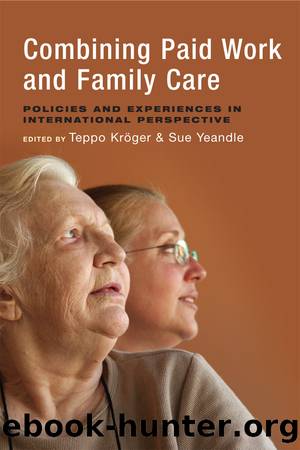
Author:Kröger, Teppo & Yeandle, Sue [Kröger, Teppo & Yeandle, Sue]
Language: eng
Format: epub
Tags: Business & Economics, Labor, General, Political Science, Labor & Industrial Relations, Public Policy, Social Services & Welfare, Social Policy, Social Science, Gerontology
ISBN: 9781447306818
Google: 6EIbAgAAQBAJ
Goodreads: 15999769
Publisher: Policy Press
Published: 2013-04-30T07:31:21+00:00
SEVEN
Reconciling work and care for parent-carers of disabled children in Australia and England: uncertain progress
Sue Yeandle and kylie valentine
Introduction
In both Australia and England, the needs of families with a sick or disabled child are recognised and addressed in legislation and in national health, care and education systems. Relevant policy frameworks and support measures, which continue to develop and change, have been put in place over several decades (HMT and DES, 2007; Broach et al, 2010) and both countries have made disability discrimination illegal (including in education and social support systems). Each has policies designed to meet the additional educational needs of children with a disability, and offers financial support that parent-carers may claim. Yet, in both countries, many parent-carers feel unsupported, their health and financial circumstances are poor compared with those of other parents and carers, and their employment rates are low (Audit Commission, 2003; Burchardt, 2006; Yeandle et al, 2007; FaHCSIA, 2008).
What help do parent-carers get in these countries to enable them to reconcile work and care? Why are outcomes for them so often unsatisfactory? Is policy adaptation and change addressing these problems? This chapter begins by outlining the context for these issues, focusing first on the prevalence of sickness and disability among children in Australia and England and the services and support available to their families.
Prevalence of disability among children and their familiesâ financial circumstances
In Australia in 2009, an estimated 288,300 children aged 0â14 had a disability: over 3% of 0â4 year olds, and almost 9% of 5â14 year olds (ABS, 2011). Of these, 166,700 had a severe or profound âcore activity limitationâ, meaning that they need assistance with regular communication, mobility or self-care tasks (AIHW, 2009a; ABS, 2011). Estimates suggest that about half of all disabled children aged 0â14 have two or more disabilities and that almost 7% have four or five (AIHW, 2009b). The type of disability a child has can be important to his or her care needs. A review of payments to primary parent-carers in Australia found intellectual and learning disabilities (4.3% of all children) and physical/diverse1 disabilities (4.2%) to be most prevalent (FaHCSIA, 2007: 4), while analysis of the primary disability of service users found that this was âintellectualâ for about 30% of people, âphysicalâ for almost 17% and âautismâ for about 6% (SCRGSP, 2011: Table 14A.13).
Since the introduction of deinstitutionalisation in the 1980s, most policies are designed to support parents to raise their children at home, and such care is usual for most disabled children in Australia (AIHW, 2004), although some parents of children with profound disabilities express frustration that high-quality residential placements are not available (Ombudsman, 2004; Eyler, 2005; SCCA, 2005). There is a tension between these expressed wishes of some carers for residential placements and the policy goal â driven by disabled people â that disabled people live in the community. Parent-carers of disabled children therefore have a political âvoiceâ in Australia that carers of other people do not have, but often live in disadvantaged circumstances. Their incomes are often
Download
This site does not store any files on its server. We only index and link to content provided by other sites. Please contact the content providers to delete copyright contents if any and email us, we'll remove relevant links or contents immediately.
What's Done in Darkness by Kayla Perrin(26969)
The Ultimate Python Exercise Book: 700 Practical Exercises for Beginners with Quiz Questions by Copy(20866)
De Souza H. Master the Age of Artificial Intelligences. The Basic Guide...2024 by Unknown(20623)
D:\Jan\FTP\HOL\Work\Alien Breed - Tower Assault CD32 Alien Breed II - The Horror Continues Manual 1.jpg by PDFCreator(20543)
The Fifty Shades Trilogy & Grey by E L James(19477)
Shot Through the Heart: DI Grace Fisher 2 by Isabelle Grey(19391)
Shot Through the Heart by Mercy Celeste(19248)
Wolf & Parchment: New Theory Spice & Wolf, Vol. 10 by Isuna Hasekura and Jyuu Ayakura(17394)
Python GUI Applications using PyQt5 : The hands-on guide to build apps with Python by Verdugo Leire(17367)
Peren F. Statistics for Business and Economics...Essential Formulas 3ed 2025 by Unknown(17206)
Wolf & Parchment: New Theory Spice & Wolf, Vol. 03 by Isuna Hasekura and Jyuu Ayakura & Jyuu Ayakura(17109)
Wolf & Parchment: New Theory Spice & Wolf, Vol. 01 by Isuna Hasekura and Jyuu Ayakura & Jyuu Ayakura(16720)
The Subtle Art of Not Giving a F*ck by Mark Manson(14853)
The 3rd Cycle of the Betrayed Series Collection: Extremely Controversial Historical Thrillers (Betrayed Series Boxed set) by McCray Carolyn(14447)
Stepbrother Stories 2 - 21 Taboo Story Collection (Brother Sister Stepbrother Stepsister Taboo Pseudo Incest Family Virgin Creampie Pregnant Forced Pregnancy Breeding) by Roxi Harding(14241)
Cozy crochet hats: 7 Stylish and Beginner-Friendly Patterns from Baby Beanies to Trendy Bucket Hats by Vanilla Lazy(13516)
Scorched Earth by Nick Kyme(13111)
Reichel W. Numerical methods for Electrical Engineering, Meteorology,...2022 by Unknown(12986)
Drei Generationen auf dem Jakobsweg by Stein Pia(11276)
